Is spring or autumn better for Everest Base Camp?
Autumn: best for clear views and stable trekking conditions
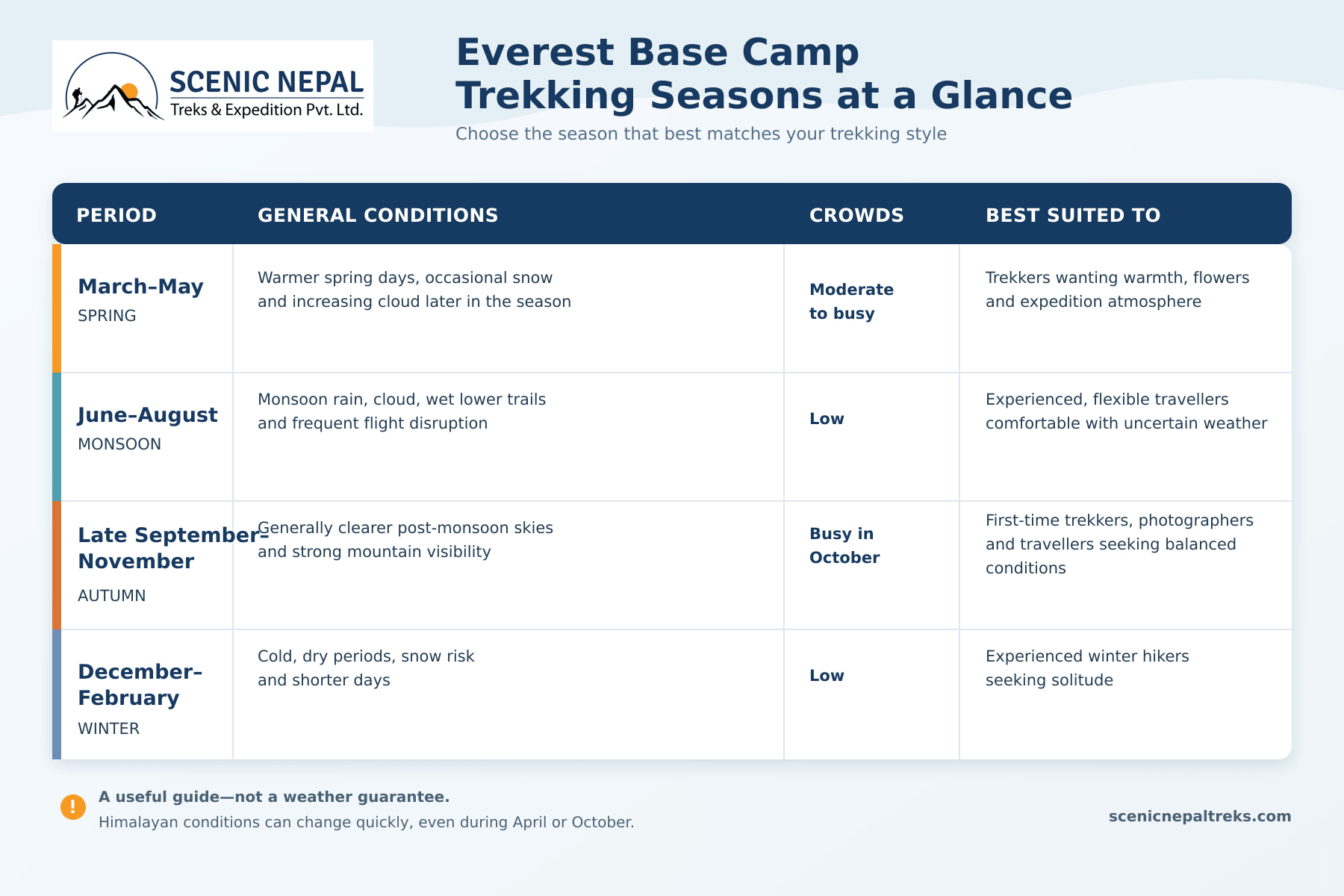
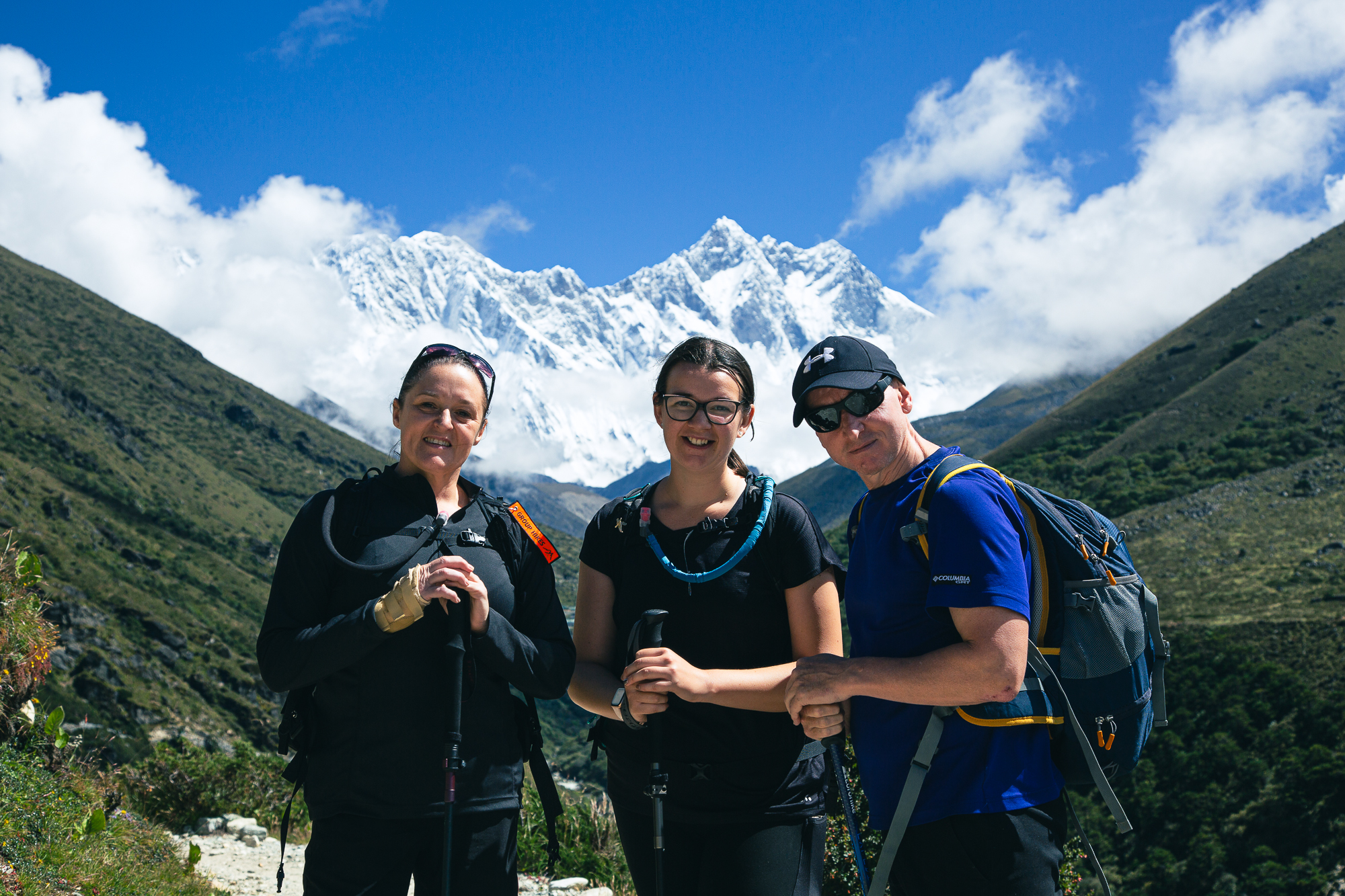
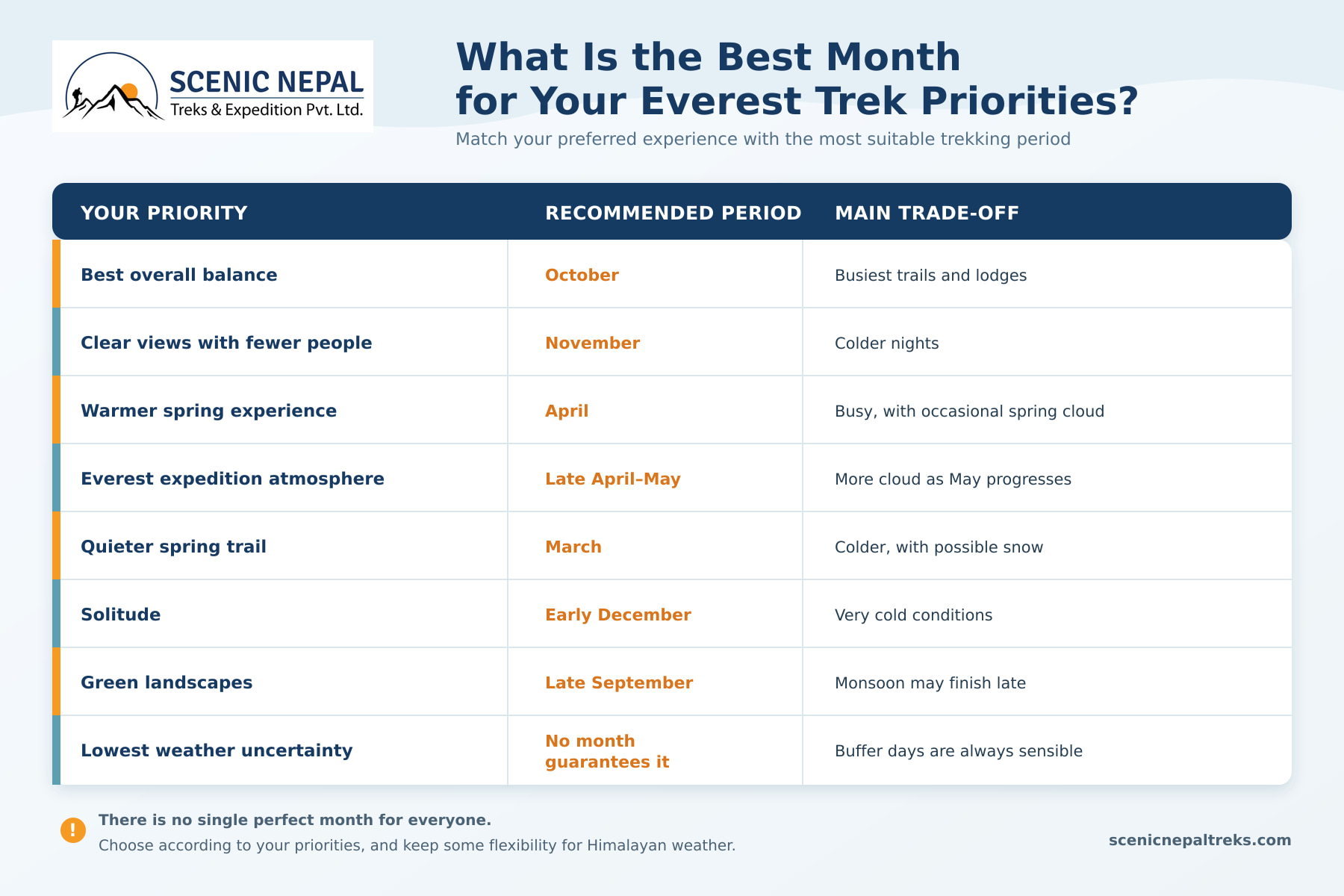
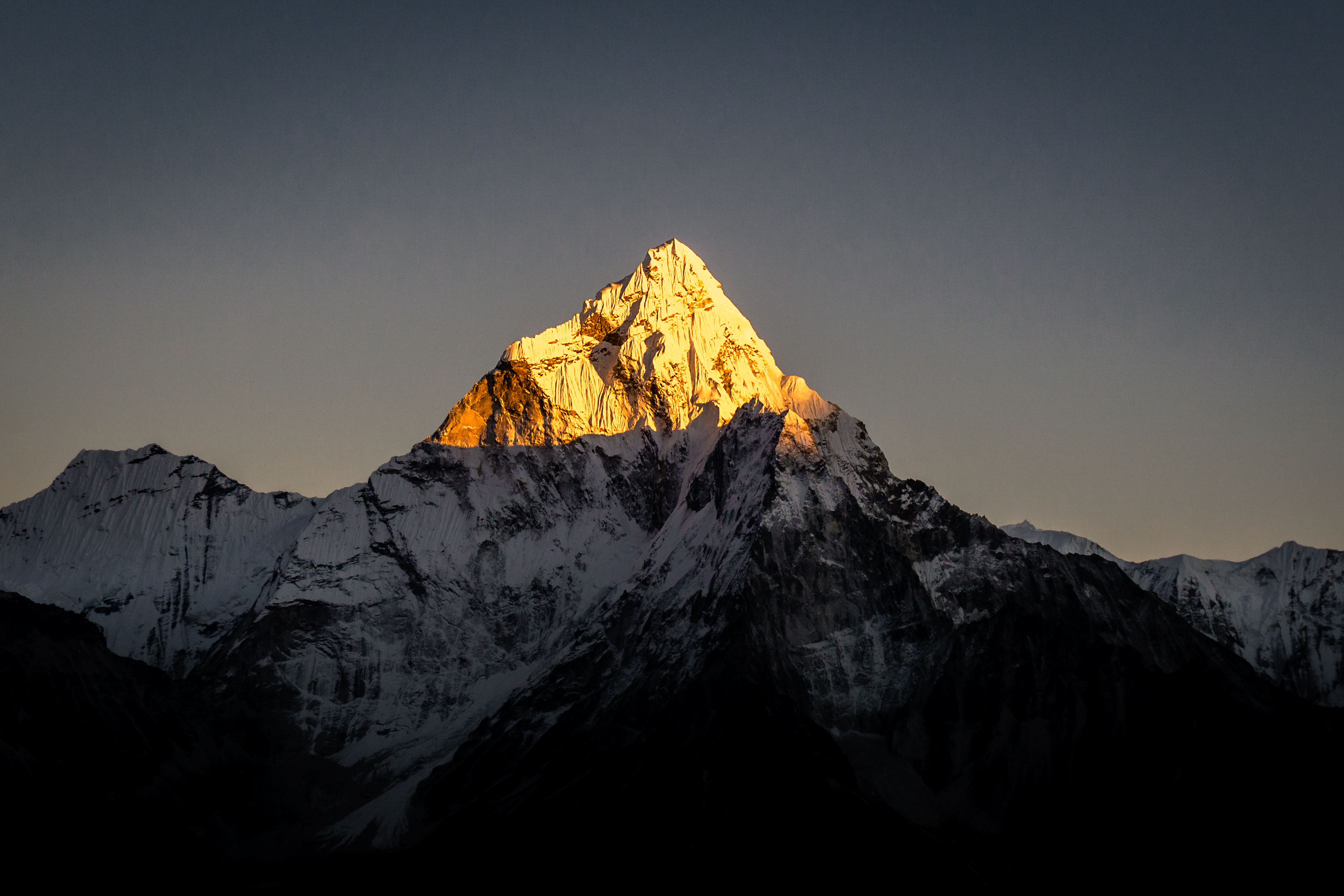
Autumn normally begins once Nepal’s summer monsoon withdraws. The landscape is refreshed by rain, and the air often becomes clearer and drier. From late September through November, trekkers frequently enjoy excellent views of Everest, Lhotse, Ama Dablam, Thamserku and the surrounding Khumbu peaks.
October is especially popular because it combines relatively comfortable daytime walking conditions with good visibility. Its disadvantage is popularity: flights, trails and teahouses can all be busy.
November becomes colder, particularly above Dingboche, but often retains crisp visibility. It can be a good compromise for travellers who want strong mountain views without choosing the busiest weeks of October.
Choose autumn if:
- Clear mountain views are your main priority.
- You are making your first high-altitude trek.
- You want the broadest choice of open teahouses.
- You do not mind sharing the trail with more trekkers.
- You prefer drier conditions over warmer spring days.
Spring: best for warmth, flowers and Base Camp activity
March to May is the second main Everest Base Camp trekking season. March begins colder, and snow may remain at higher elevations. Conditions generally become warmer through April, while rhododendrons add colour to lower parts of the route.
April offers one of the most enjoyable balances of daylight, temperature and scenery. Climbers and expedition teams also begin establishing their camps for the Everest summit season, so Base Camp feels more active than it does in autumn.
By May, the days are warmer, but moisture and afternoon cloud can increase as the monsoon approaches. Morning views may still be beautiful, which is why guides often recommend starting early.
Choose spring if:
- You prefer warmer daytime conditions.
- You want to see flowering forests at lower elevations.
- You would enjoy seeing the expedition season around Base Camp.
- You are comfortable with occasional cloud, wind or snowfall.
- October does not fit your work or holiday schedule.
Everest Base Camp weather by month
Everest Base Camp in January
January is one of the coldest and quietest months. Clear days are possible, but temperatures at Gorak Shep and Base Camp can fall far below freezing, especially overnight. Snow and ice may affect parts of the trail, while frozen water pipes and basic lodge facilities can make daily life harder.
January is better suited to experienced winter trekkers with appropriate clothing, flexible plans and realistic expectations. It is not our first recommendation for someone new to high-altitude trekking.
Everest Base Camp in February
February remains cold, although conditions may begin improving toward the end of the month. Trails are quiet, and mountain visibility can be excellent during settled weather.
Heavy snow is still possible, and some lodges may offer limited services. Late February can work for properly equipped trekkers who accept winter conditions, but March is usually a more comfortable choice.
Everest Base Camp in March
March marks the beginning of the spring trekking season. Early March can still feel like winter at higher elevations, but the days gradually become longer and warmer.
Crowds are generally lighter than in April. Snowfall can still occur, so warm layers, waterproof protection and flexible expectations remain important. March suits trekkers who want spring conditions without the peak-season numbers.
April is one of the best months for the Everest Base Camp trek. Daytime walking is generally more comfortable, the lower forests can be colourful, and expedition teams begin gathering at Base Camp.
The trail becomes busy around popular locations such as Namche Bazaar, Tengboche and Gorak Shep. Reserving accommodation through an established local operator is particularly valuable during this period.
April is an excellent choice for first-time EBC trekkers who prioritise warmer conditions and a lively Himalayan atmosphere.
Everest Base Camp in May
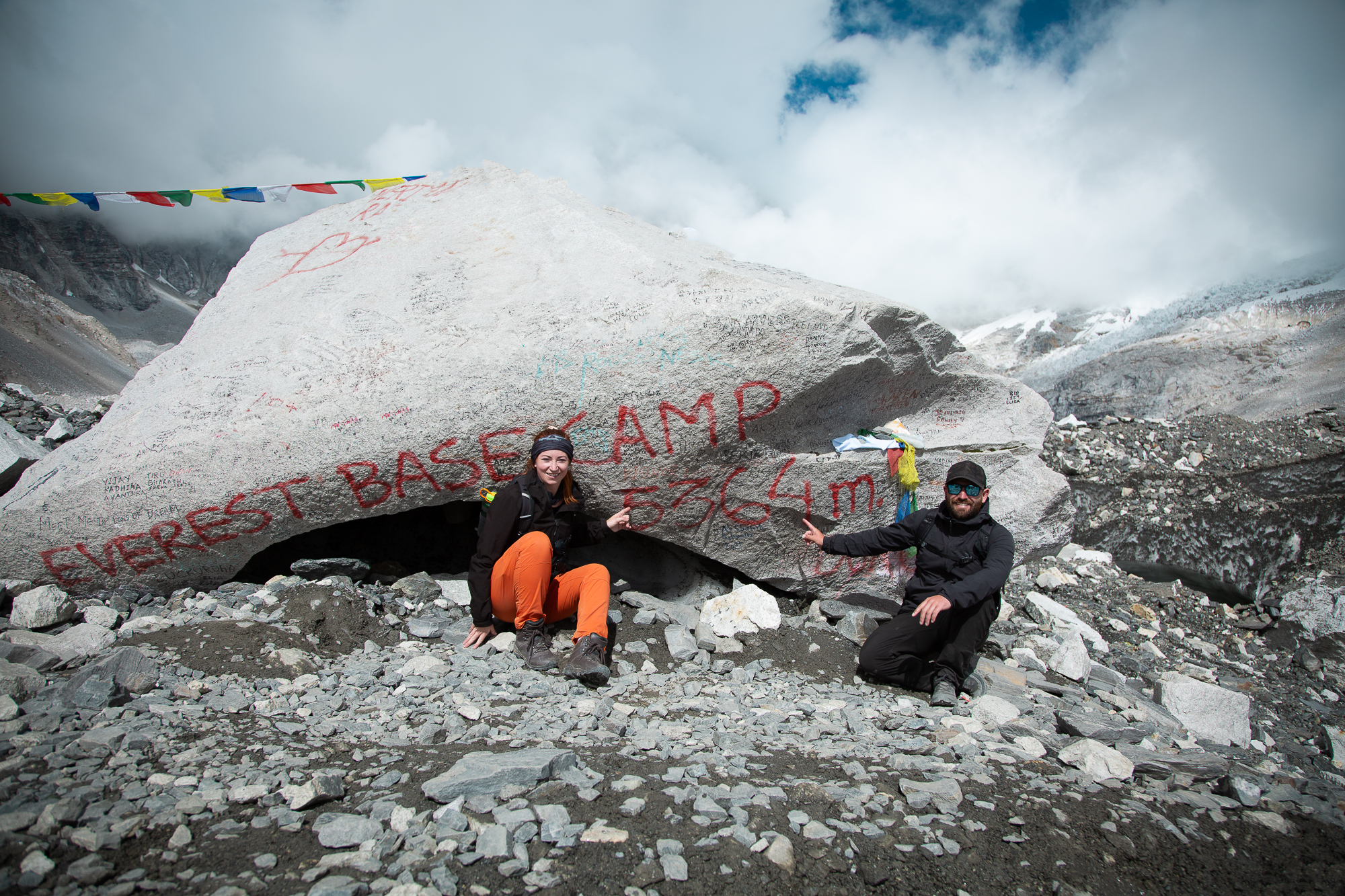
May is warmer, and Base Camp is usually at its most active during the Everest climbing season. Trekkers may see colourful expedition tents from the designated visitor area, although trekking visitors do not enter climbing teams’ private camps without permission.
Cloud often develops later in the day as the monsoon approaches. Flights may face additional disruption, and views can be less consistent than in April. Starting early and keeping flexibility around Lukla flights becomes especially important.
Everest Base Camp in June
June normally marks the transition into Nepal’s monsoon. Lower sections of the trail become wetter, cloud may hide the mountains, and Lukla flights can be delayed or cancelled.
There are fewer trekkers, but reduced crowds do not necessarily mean an easier experience. Wet paths, uncertain flights and limited views make June a less attractive choice for most first-time visitors.
Everest Base Camp in July and August
July and August fall within the main monsoon period. The lower Khumbu receives rain, trails can become muddy, and cloud frequently affects flights and mountain visibility.
Rainfall is not constant every hour, and the higher valley lies in a different microclimate from Kathmandu, but travel becomes less predictable. Landslides and transport disruption elsewhere in Nepal can also affect the wider journey.
We generally recommend that first-time international visitors choose another season unless they have considerable flexibility.
Everest Base Camp in September
September is a transition month. Early September can still be wet and cloudy, while conditions often improve later in the month as the monsoon withdraws.
Late September can offer greener landscapes and fewer people than October, but the exact end of the monsoon varies each year. Travellers choosing September should keep buffer time and avoid assuming that clear autumn weather will arrive on a fixed date.
Everest Base Camp in October
October is usually the best month for Everest Base Camp for travellers seeking the most balanced conditions. Post-monsoon skies are often clear, mountain visibility is strong, and daytime temperatures are generally suitable for steady trekking.
It is also one of the busiest months. Lukla flights are heavily booked, popular teahouses fill quickly, and the route can feel social rather than remote. A well-organised itinerary and advance arrangements are important.
Even in October, snowstorms and flight cancellations are possible. A favourable season reduces weather risk; it never removes it.
Everest Base Camp in November
November is another excellent month. Skies are often dry and clear, while the trail generally becomes quieter after the busiest October weeks.
The main trade-off is cold. Nights above 4,000 metres can be severe, and unheated teahouse bedrooms feel considerably colder than the dining room. Trekkers need a suitable sleeping bag, insulated jacket, warm gloves and layered clothing.
Everest Base Camp in December
Early December can provide clear views, quieter trails and a peaceful experience. As winter develops, temperatures fall sharply, daylight becomes shorter and snow can affect higher sections.
December trekking is possible with a capable guide and proper equipment, but it demands greater cold tolerance. Some teahouses may close or reduce their services later in the month.
How the season affects Lukla flights
Most Everest Base Camp itineraries begin with a flight to Lukla. During busy trekking periods, flights may operate from Ramechhap Airport rather than Kathmandu, requiring an early drive from Kathmandu. The operating airport is determined by aviation arrangements and seasonal traffic, so it should be confirmed close to departure.
Cloud, wind and poor visibility can delay or cancel flights in any season. Disruption is generally more frequent during the monsoon, but it can also happen in spring, autumn or winter.
We strongly recommend:
- Keeping at least one flexible night in Kathmandu after the trek.
- Avoiding an international departure immediately after the planned Lukla flight.
- Carrying essential medication and valuables in your daypack.
- Purchasing insurance that covers trekking to at least 5,545 metres and emergency evacuation.
- Understanding the financial conditions for any helicopter alternative before agreeing to it.
Does the best season prevent altitude sickness?
No. Good weather does not protect anyone from altitude illness.
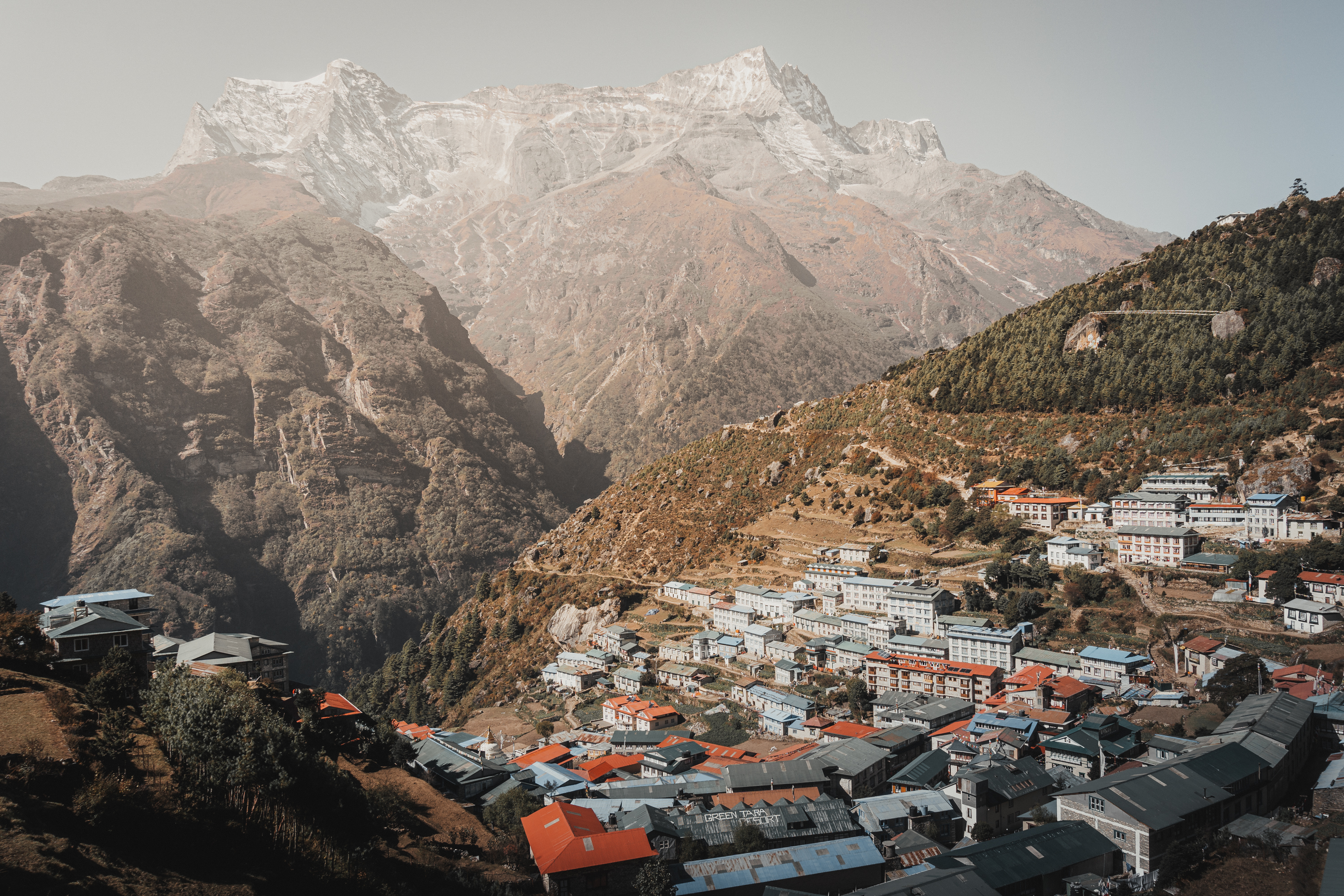
The EBC route rises from Lukla at approximately 2,860 metres to more than 5,000 metres. Acclimatisation depends mainly on the rate of ascent, rest days, hydration, individual response and sensible decision-making—not the season.
The acute acclimatisation process during the first several days at altitude is particularly important, according to the CDC’s high-altitude travel guidance.
A responsible 14-day itinerary should include acclimatisation days around Namche Bazaar and Dingboche. Trekkers must report headaches, nausea, unusual fatigue, dizziness, poor coordination or breathing difficulty to their guide.
Do not ascend with worsening symptoms. Descent is the most important response when serious altitude illness is suspected, and medication should be discussed with a qualified medical professional before travelling.
What should you expect on Scenic Nepal Treks’ 14-day itinerary?
Our 14-day Everest Base Camp Trek is designed around a gradual journey through the Khumbu rather than rushing directly to Base Camp. The route normally includes:
- A flight to Lukla and trek through Phakding
- Namche Bazaar and an acclimatisation day
- Tengboche and its important Buddhist monastery
- Dingboche and a second acclimatisation day
- Lobuche and Gorak Shep
- Everest Base Camp at approximately 5,364 metres
- An optional early hike to Kala Patthar at approximately 5,545 metres
- Descent through the Khumbu and return flight from Lukla
- Two Kathmandu hotel nights
Most walking days involve approximately five to seven hours, although the Base Camp and Kala Patthar sections may be longer. Distance alone can be misleading: altitude, cold, rough ground and repeated ascents make a Himalayan kilometre harder than a kilometre at home.
If you are unsure whether spring or autumn suits your fitness, schedule and expectations, contact Scenic Nepal Treks before booking flights. As a Kathmandu-based local operator, we can advise you using current trail, lodge and aviation conditions—not only general seasonal averages.
Accommodation and meals in different seasons
Accommodation on the trail is in locally operated teahouses. Rooms are normally simple and twin-sharing, with two beds and limited insulation. Toilets and washing facilities vary by settlement. At busy times, especially in Gorak Shep, room choice may be limited.
The dining room is usually the warmest communal area. Bedrooms are generally not heated, which matters particularly in November, December, January and February.
Breakfast, lunch and dinner are selected from teahouse menus during the trek. Common choices include dal bhat, soup, noodles, rice, potatoes, pasta, eggs and porridge. Menu variety may decrease at higher elevations or in winter.
Scenic Nepal Treks’ package includes three meals a day during the trek. Bottled drinks, tea, coffee, hot showers, charging and Wi-Fi are personal expenses unless stated otherwise in your final quotation.
Permits, insurance and preparation
The normal EBC route passes through Sagarmatha National Park and the Khumbu local area. Required local and park permits are included in the Scenic Nepal Treks package. The Nepal Tourism Board’s Everest Base Camp information describes the route from Lukla through Namche and the Sagarmatha National Park checkpoint.
Insurance should cover:
- Trekking up to at least 5,545 metres
- Emergency medical treatment
- Helicopter evacuation when medically necessary
- Trip interruption and cancellation
- Flight delays or missed connections
- The activities and dates shown in your itinerary
Read the altitude limit and exclusions rather than relying only on the phrase “adventure travel.” The Government of Canada, for example, warns that remote evacuations may be delayed by communications, payment or insurer authorisation and advises travellers to examine rescue arrangements carefully in its Nepal travel advice.
Advice for UK, Canadian, US and Australian travellers
- UK travellers: Allow time for long connections through the Middle East or South Asia. Check that your policy covers trekking above 5,000 metres and helicopter evacuation—not merely hiking.
- Canadian travellers: Connections can be long, particularly from cities without a direct link to a major Asian or Middle Eastern hub. Arrive with recovery time before beginning the trek.
- US travellers: Review altitude and evacuation coverage carefully, as domestic medical insurance may provide limited or no overseas protection.
- Australian travellers: Travel time may be shorter than from North America, but flight connections still justify arriving before the trekking programme rather than trying to connect directly to Lukla.
Travellers from every country should check their government’s current Nepal travel advice and consult a travel-health professional regarding personal health, medication and vaccinations.
What to pack according to the season
Every trekker needs a layered system:
- Moisture-wicking base layers
- Fleece or insulated mid-layer
- Warm down jacket
- Waterproof and windproof outer jacket
- Waterproof trousers
- Warm hat and sun hat
- Insulated and lighter gloves
- Broken-in trekking boots
- Warm trekking socks
- UV-protective sunglasses
- Headlamp
- Suitable sleeping bag
- Sun protection
- Refillable water bottles
- Personal medication and blister care
- Power bank and spare batteries
Add more insulation for November through February. For May and the monsoon transition, reliable waterproofing and dry bags become especially important.
Lukla flights have strict baggage allowances, which can vary by airline and operational arrangement. Scenic Nepal Treks will confirm the applicable limit before departure. A shared porter is included for every two trekkers; the precise duffel allowance should be stated in the final booking documents as [CONFIRM].
How Scenic Nepal Treks supports you on the ground
Choosing the right month is only one part of planning the trek. Local organisation becomes especially valuable when weather, flights or trail conditions change.
Scenic Nepal Treks provides:
- An experienced trekking guide
- One porter shared between two trekkers
- Two planned acclimatisation days
- Trekking permits and entrance fees
- Domestic flights and required ground transfers
- Twin-sharing teahouse accommodation
- Three meals each trekking day
- Two Kathmandu hotel nights
- Airport arrival and departure transfers
- First-aid support and a pulse oximeter
- Pre-trek briefing and packing advice
- Local coordination when flights or weather disrupt the plan
No trekking company can guarantee weather, successful arrival at Base Camp or freedom from altitude illness. What a responsible local operator can do is build a sensible itinerary, monitor each trekker, respond conservatively to symptoms and adjust plans when conditions require it.
What is the best time for the Everest Base Camp trek?
The main trekking seasons are October to November and March to May. October offers the strongest all-round balance, while April is an excellent warmer alternative.
Is April or October better for Everest Base Camp?
October usually offers clearer post-monsoon visibility. April normally provides warmer spring days, flowering forests and an active climbing-season atmosphere. Choose according to your priorities rather than expecting perfect weather in either month.
Is November too cold for the EBC trek?
November is cold, particularly overnight above Dingboche, but it remains one of the best months for clear views. A warm sleeping bag and an effective layering system are essential.
Can I trek to Everest Base Camp in December?
Yes, particularly in early December, but expect colder nights, shorter daylight hours, possible snow and fewer open lodges. Winter trekking requires better cold-weather preparation and greater flexibility.
Should I trek to Everest Base Camp during the monsoon?
It is possible, but June through August brings more cloud, rain, wet trails and flight disruption. We generally do not recommend it for first-time EBC trekkers.
When can I see expedition tents at Everest Base Camp?
The main climbing season is in spring. Expedition activity is normally most visible from April into May. Trekking visitors must respect designated areas and expedition camps.
Which month has fewer crowds?
March, late November and early December are generally quieter than April and October. Conditions are colder or less predictable, so reduced crowds come with trade-offs.
Can Lukla flights be cancelled during the best season?
Yes. Lukla flights depend on visibility, wind and operational conditions. Delays and cancellations can happen in every month, so a buffer night before your international flight is strongly recommended.
Does Scenic Nepal Treks offer flexible departure dates?
Private departures can be arranged on flexible dates. Fixed group departure dates are [CONFIRM]. Contact the company before purchasing international flights.
Plan your Everest Base Camp trek with a local team
The best month depends on what matters most to you. For the clearest all-round choice, consider October. For warmer spring trekking and the energy of climbing season, consider April. For fewer people and crisp views, November can be excellent if you are prepared for colder nights.
Scenic Nepal Treks is based in Kathmandu and supports you from arrival through the trek and your return from the mountains. We can help compare dates, plan your 14-day itinerary and explain the realistic advantages and compromises of each season.