Everest Base Camp Trek from the USA
Traveling from America to Nepal
We understand that reaching Nepal from the United States is a major international journey.
Depending on where you live, your journey may look something like:
USA → International Transit Airport → Kathmandu, Nepal
You may begin your journey from New York, Los Angeles, Chicago, San Francisco, Houston, Dallas, Seattle or another American city.
There are normally one or more international connections between the United States and Kathmandu.
Your exact route depends on your airline, departure city and travel dates.
When booking your international flight, we recommend looking beyond the ticket price.
A slightly longer or more convenient connection may make your journey much easier, especially when you are traveling to Nepal for a high-altitude trek.
Before purchasing your flight, check:
- Number of connections
- Total travel time
- Connection duration
- Baggage allowance
- Whether baggage is checked through to Kathmandu
- Whether you need to change terminals
- Whether you need to change airports
- Transit visa requirements
- Arrival time in Kathmandu
- Return-flight schedule
If you have questions about your arrival or departure schedule, our team can help you understand how your international flights fit around the trekking itinerary.
Everest Base Camp Trek from Canada
Traveling from Canada to Nepal
For travelers from Canada, the journey generally involves one or more international connections before arriving in Kathmandu.
You may travel from:
- Toronto
- Vancouver
- Calgary
- Montreal
- Edmonton
- Ottawa
- Or another Canadian city
Your exact routing will depend on your airline and travel dates.
A typical journey may look like:
Canada → International Transit Hub → Kathmandu, Nepal
When selecting your flight, we recommend allowing sufficient connection time and checking the transit requirements for every country through which you travel.
If you are booking separate tickets rather than one protected itinerary, allow additional time because the airlines may not be responsible for a missed connection between separate bookings.
Flight Connections and Transit
Do I Need a Transit Visa?
This is one of the most common questions we receive from international travelers.
The answer depends on your passport and exact flight itinerary.
Transit rules vary from country to country.
Whether you need a transit visa can depend on:
- Your nationality
- Your passport
- The airport where you connect
- Whether you remain inside the international transit area
- Whether you need to collect your luggage
- Whether you change terminals
- Whether you change airports
- Whether your flights are on one ticket
- The length of your connection
We recommend checking the current requirements directly with your airline and the relevant immigration authority before purchasing your flight.
Our advice
Before booking your international ticket, make sure you understand:
Where are you connecting?
Do you need a transit visa?
Do you need to collect your luggage?
Do you need to pass immigration?
Do you need to change terminals?
Do you need to change airports?
What happens if your first flight is delayed?
Transit requirements can change, so always verify the latest rules before departure.
How Long Is the Journey from North America to Nepal?
The total travel time varies depending on your departure city, airline and connection.
Traveling from North America to Nepal can be physically tiring.
You may spend many hours on aircraft and at airports while crossing several time zones.
This is one of the reasons we designed this package with two nights in Kathmandu before the trek.
We don't want you to arrive in Nepal after a long international journey and immediately feel that you have to start a demanding mountain trek.
Take a breath.
Sleep.
Explore Kathmandu.
Adjust to Nepal.
Then begin your Everest adventure.
Jet Lag Before Everest Base Camp
Give Your Body Time to Adjust
Jet lag is a real consideration when traveling from North America to Nepal.
Your body may still be operating on your home time zone when you arrive in Kathmandu.
You may experience:
- Tiredness
- Difficulty sleeping
- Waking during the night
- Daytime sleepiness
- Difficulty concentrating
- Changes in appetite
- General fatigue
Every traveler reacts differently.
We recommend:
Before leaving home:
- Get enough sleep before your flight.
- Prepare your body for the time-zone change if practical.
- Avoid starting your journey already exhausted.
During the flight:
- Drink water regularly.
- Move around periodically when safe.
- Try to sleep according to Nepal time when practical.
- Avoid excessive alcohol.
After arriving in Kathmandu:
- Get daylight.
- Drink water.
- Eat normally.
- Rest.
- Establish a local sleep schedule.
- Don't overload your first day with activities.
Your first priority is to recover from the journey.
Why We Include 2 Nights in Kathmandu Before the Trek
We have designed these two nights specifically with international travelers in mind.
When you arrive in Kathmandu, you are not simply arriving at another airport.
You have traveled halfway around the world.
You may be tired.
You may be jet-lagged.
You may need time to organize your luggage and trekking equipment.
You may want to experience Kathmandu before entering the mountains.
That is why we give you time.
Your first two nights allow you to:
Rest
Recover from your international journey.
Adjust
Begin adapting to Nepal time and your new surroundings.
Prepare
Get your trekking equipment and luggage organized.
Meet
Meet your guide and trekking team.
Explore
Experience some of Kathmandu before heading into the Himalayas.
Trek Preparation in Kathmandu
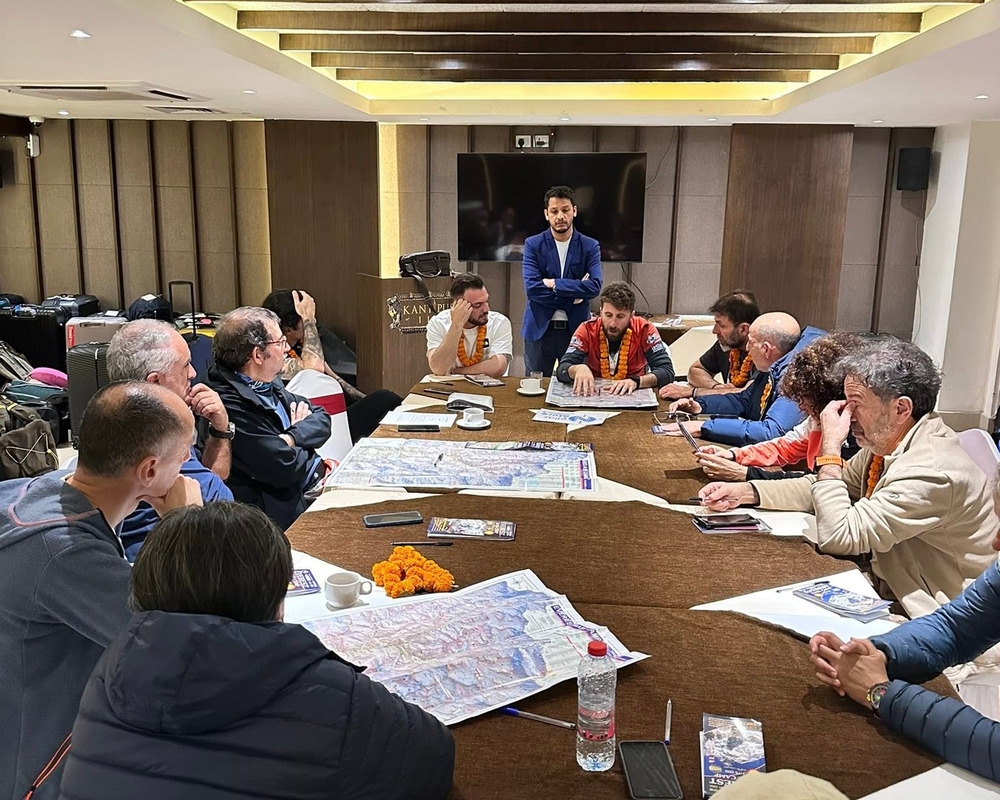
Before heading into the Everest region, our team will help you complete the necessary preparations for your trek.
Depending on your confirmed package, this may include:
- Trek briefing
- Introduction to your guide
- Equipment check
- Luggage preparation
- Trekking permit arrangements
- TIMS arrangements
- Flight confirmation
- Final trekking preparation
We will explain the important aspects of your trek and answer your questions before you leave Kathmandu.
Flying to Lukla
After your Kathmandu preparation, the adventure moves into the mountains.
The flight toward Lukla is one of the most exciting parts of the Everest Base Camp journey.
As you leave Kathmandu behind, the landscape changes dramatically.
Soon you are surrounded by Himalayan hills and mountains.
Lukla is the traditional gateway for trekkers heading toward Everest Base Camp.
Flight operations can be affected by weather and operational conditions.
Depending on current aviation arrangements, flights may operate from Kathmandu or Ramechhap/Manthali.
Our team monitors the flight situation and assists with the trekking logistics according to the conditions at the time of travel.
Lukla Flight Delays – What Should You Expect?
Mountain aviation is different from flying between large international airports.
Weather can change quickly in the Himalayas.
Flights can occasionally be delayed, rescheduled or cancelled.
This is something every Everest Base Camp traveler should understand before booking the trek.
We recommend that you:
- Keep your itinerary flexible
- Have suitable travel insurance
- Avoid scheduling your international departure too tightly
- Follow our team's advice regarding flight conditions
We recommend allowing additional flexibility around your Nepal trip whenever possible.
How Difficult Is Everest Base Camp Trek?
Everest Base Camp is a challenging high-altitude trek.
You do not need technical mountaineering skills to complete the standard trekking route, but you should be physically prepared for multiple days of walking in mountainous terrain.
You should expect:
- 5–8 hours of walking on many trekking days
- Steep uphill sections
- Long downhill sections
- Stone steps
- Uneven trails
- Suspension bridges
- Cold temperatures
- High altitude
- Reduced oxygen availability
- Basic teahouse accommodation
- Variable mountain weather
Previous Himalayan trekking experience is helpful but not essential.
Good preparation, appropriate pacing and following your guide's instructions are important.
Important
Physical fitness does not eliminate altitude-illness risk.
If you have concerns about high-altitude travel, an existing medical condition or medications you take, consult a qualified healthcare professional before your trip.
Best Time for Everest Base Camp Trek
Everest Base Camp can be trekked during different seasons, but conditions vary significantly.
Spring – March to May
Spring is one of the main trekking periods.
You can generally expect:
- Increasing temperatures
- Good trekking conditions
- Mountain views depending on weather
- Rhododendron blooms at lower elevations
- Busy trails during popular periods
Autumn – September to November
Autumn is another major trekking season.
Potential advantages include:
- Generally favorable trekking conditions
- Cooler temperatures
- Good mountain visibility during suitable weather
- Popular trekking atmosphere
Winter – December to February
Winter trekking is possible but temperatures can be very cold, particularly at higher elevations.
Snow and cold conditions may affect the route and accommodation.
Monsoon – June to August
Monsoon brings significant rainfall to much of Nepal.
Cloud, rain and transportation conditions can affect trekking and flights.
Which season should you choose?
The right season depends on your priorities, including weather, temperature, crowds, photography and flexibility.
Our team can help you choose dates based on your travel plans.
Everest Base Camp Trek Packing List
Clothing
- Moisture-wicking base layers
- Trekking shirts
- Fleece jacket
- Insulated/down jacket
- Waterproof jacket
- Trekking trousers
- Thermal underwear
- Warm hat
- Sun hat
- Gloves
- Warm trekking socks
Footwear
- Comfortable, broken-in trekking boots
- Camp shoes
- Trekking socks
Backpack
- Daypack
- Duffel bag [if porter service is included]
- Rain cover
- Dry bags
Sleeping Equipment
- Warm sleeping bag (Scenic Nepal Treks will provide you)
- Sleeping bag liner
- Pillowcase or travel pillow if desired
Personal Items
- Sunglasses
- Sunscreen
- Lip balm
- Toiletries
- Hand sanitizer
- Personal medications
- Personal first-aid items
Electronics
- Smartphone
- Camera
- Power bank
- Charging cables
- Universal travel adapter
Important Documents
- Passport
- Nepal visa documentation
- Travel insurance details
- Flight information
- Emergency contact information
Food on the Everest Base Camp Trek
Meals are available at teahouses and lodges throughout the trekking route. Food is served from the menu.
Common foods include:
- Dal bhat
- Rice
- Noodles
- Pasta
- Soup
- Potatoes
- Vegetables
- Eggs
- Pancakes
- Tibetan-style bread
- Porridge
- Tea
- Coffee
Vegetarian food is widely available.
If you have allergies, dietary restrictions or special nutritional requirements, tell us before departure.
Accommodation During the Trek
Kathmandu
You will stay in a comfortable Kathmandu hotel for:
- 2 nights before the trek
- 2 nights after the trek
Hotel: Hotel Kantipur Village or Similar one
Everest Region
During the trek, accommodation is generally provided in local teahouses/lodges.
Rooms are simple and comfortable but become increasingly basic at higher elevations.
Depending on location and availability, facilities may include:
- Twin-sharing rooms
- Beds
- Blankets
- Shared bathrooms
- Hot showers for an additional charge
- Charging for an additional charge
- Wi-Fi for an additional charge
Facilities vary considerably at higher elevations.
Trekking Equipment Rental in Kathmandu
If you do not want to purchase every piece of trekking equipment before leaving North America, Kathmandu provides many opportunities to rent or purchase trekking gear.
Scenic Nepal Treks can also assist with available trekking equipment rentals.
Depending on current availability, equipment may include items such as:
- Sleeping bags
- Down jackets
- Trekking poles
- Duffel bags
- Other trekking equipment
Internet and Mobile Connectivity
Internet connectivity varies throughout the Everest region.
In Kathmandu, connectivity is generally much better.
As we travel higher into the mountains, internet and mobile service can become limited.
Some lodges offer Wi-Fi, sometimes for an additional fee.
Don't worry about being connected every minute.
Sometimes one of the best things about the Everest Base Camp Trek is putting the phone away and looking at the mountains.
Nepal Tourist Visa
Travelers should check the latest Nepal visa requirements before departure.
Eligible travelers can generally obtain a tourist visa on arrival at Tribhuvan International Airport in Kathmandu.
Nepal also provides an official online immigration system.
Visa fees and regulations can change, so please verify the current requirements before your trip. Visa on Arrival details
Everest Base Camp Trek Safety
Your Safety Comes First
At Scenic Nepal Treks, your safety is our highest priority throughout the Everest Base Camp journey.
Trekking to Everest Base Camp takes you into a remote, high-altitude environment where weather, altitude, terrain and individual health can affect the experience. Our approach is therefore based on gradual acclimatization, experienced trekking staff, regular monitoring, sensible pacing and appropriate emergency procedures.
We do not expect every trekker to walk at the same speed or respond to altitude in exactly the same way. Our guides monitor the group throughout the journey and adjust the pace and daily approach when necessary.
1. Gradual Acclimatization
Altitude is one of the most important safety considerations on the Everest Base Camp Trek.
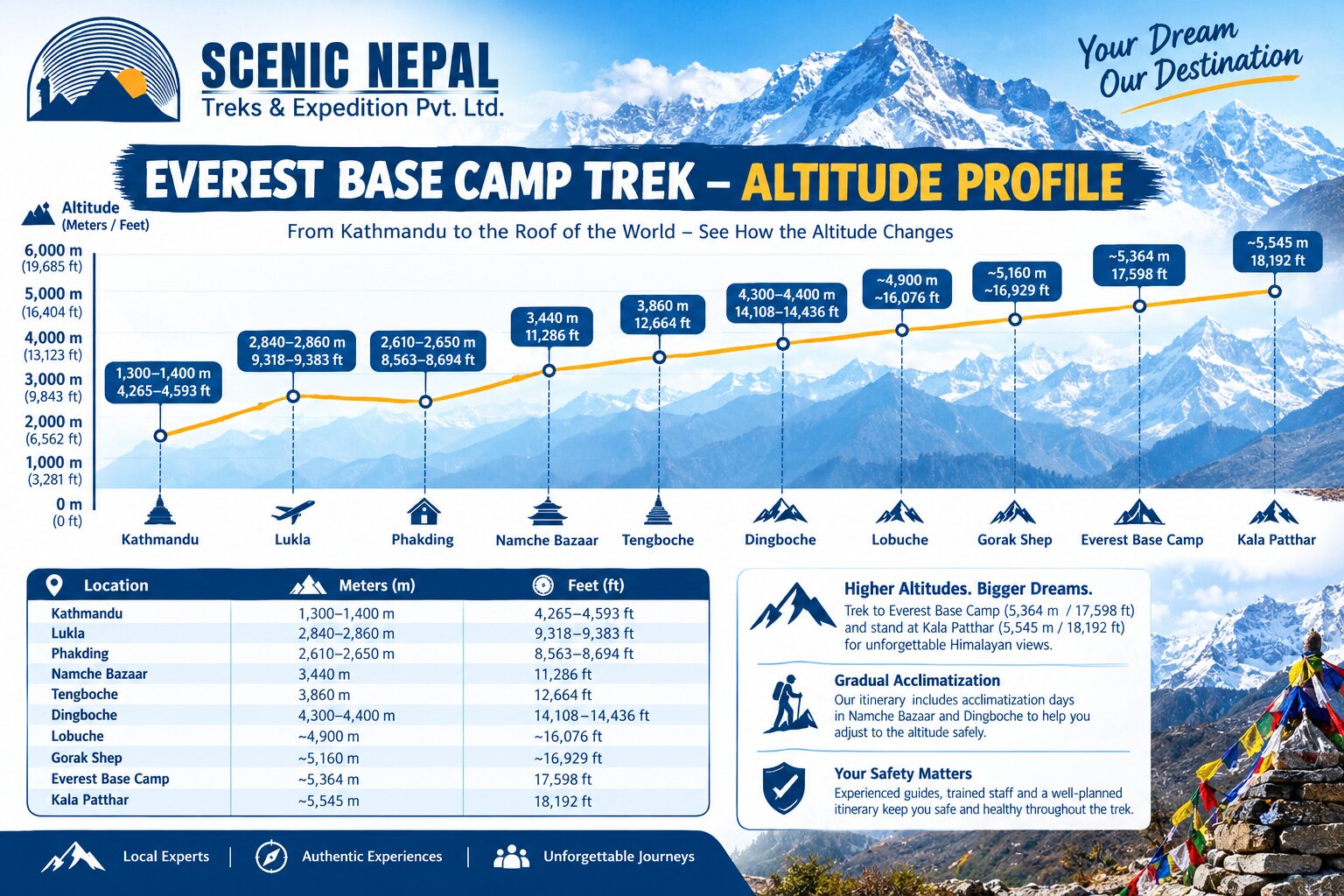
Our itinerary includes dedicated acclimatization days in:
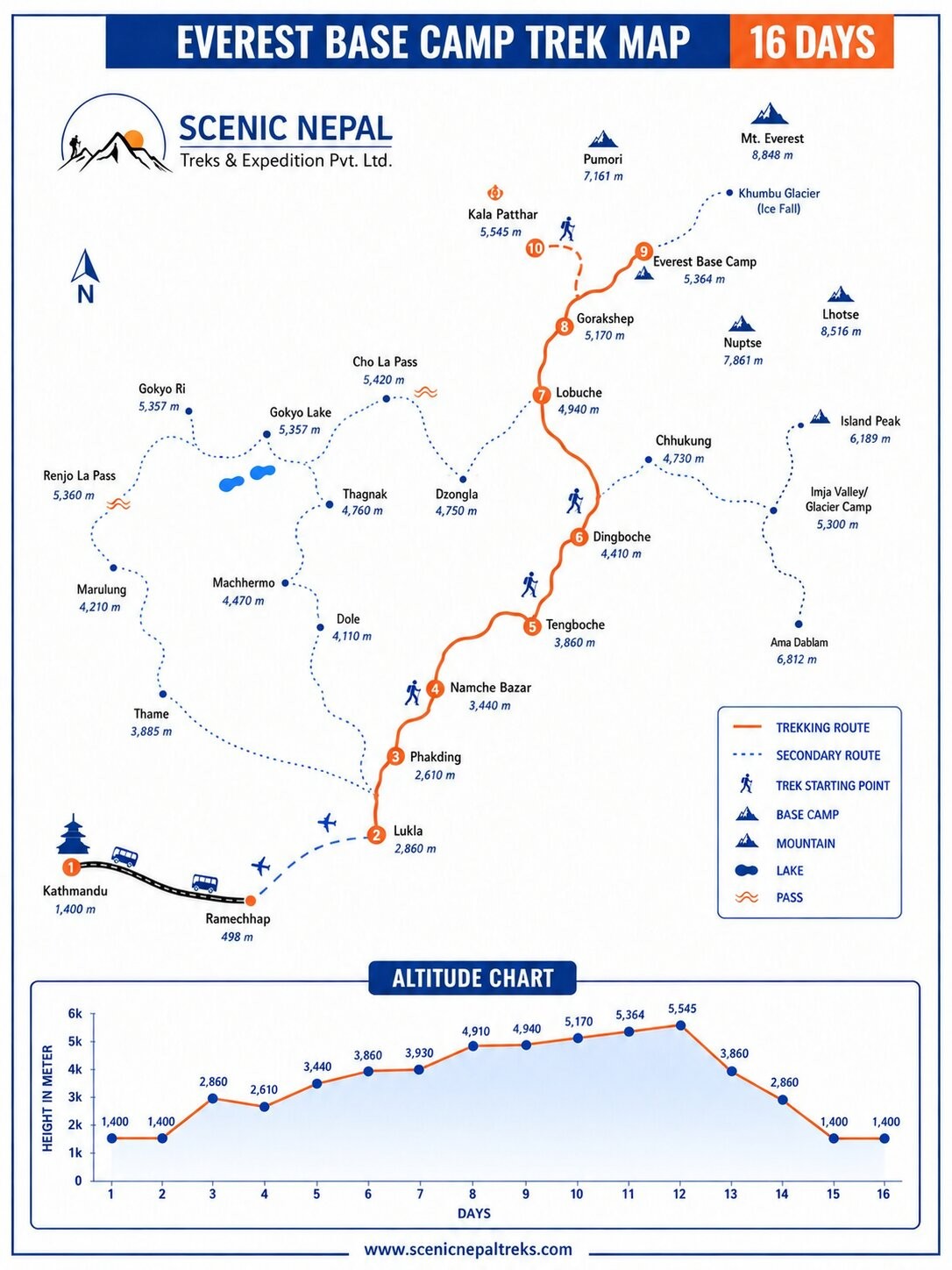
- Namche Bazaar – approximately 3,440 m / 11,286 ft
- Dingboche – approximately 4,300–4,400 m / 14,108–14,436 ft
These days are designed to give your body additional time to adjust before continuing to higher elevations.
During acclimatization days, you may take a gradual hike to a higher elevation and then return to the same village to sleep. The exact activity depends on your condition, weather and your guide's assessment.
Walk Slowly and Listen to Your Body
At high altitude, walking too quickly can make the trek unnecessarily difficult.
Our guides encourage a steady, comfortable pace rather than trying to keep up with the fastest person in the group.
If you are tired, feeling unwell or having difficulty adjusting to the altitude, tell your guide immediately.
2. Experienced Guides and Porters
Scenic Nepal Treks has more than 20 years of experience working with trekking guides and porters in Nepal.
Our trekking team plays an important role in maintaining your safety and comfort throughout the journey.
Your guide will help with:
- Route navigation
- Trekking pace
- Rest breaks
- Altitude awareness
- Daily route information
- Weather and trail-condition considerations
- Communication within the group
- Emergency coordination when required
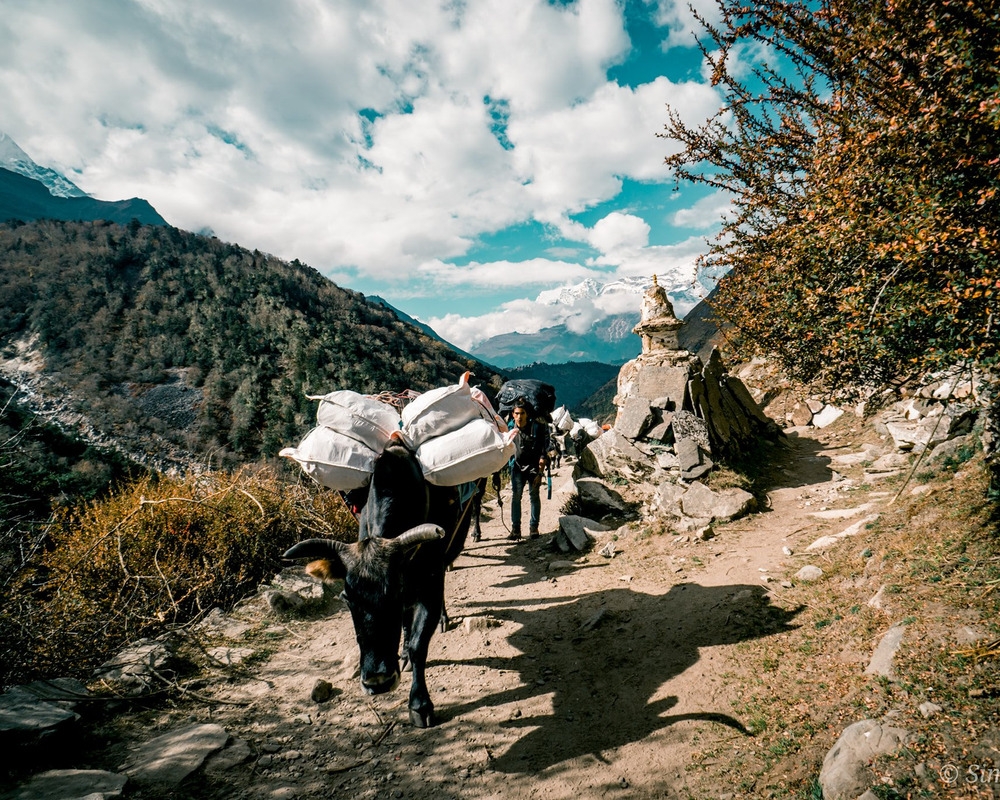
Our porters also provide important logistical support by carrying the group's trekking equipment and helping the team operate efficiently in the mountains.
3. Monitoring Altitude and Your Condition
Your guide will monitor how you are feeling throughout the trek.
At increasing elevations, you may experience changes in breathing, sleep, appetite, energy levels or overall comfort. These changes should be communicated to your guide rather than hidden.
We encourage trekkers to speak openly if they experience symptoms such as:
- Headache
- Unusual fatigue
- Dizziness
- Nausea
- Loss of appetite
- Difficulty sleeping
- Shortness of breath
- Feeling unusually weak or unwell
Your guide will assess the situation and determine the appropriate next step based on your condition and the circumstances.
Your safety is more important than maintaining the planned schedule.
4. What Happens If You Become Sick?
Not every illness requires an evacuation.
Our response depends on the severity of the situation.
If You Have Mild Symptoms or Feel Generally Unwell
If you are experiencing relatively mild symptoms or are simply exhausted, your guide may recommend:
- Taking additional rest
- Drinking fluids
- Eating and recovering
- Reducing your walking pace
- Monitoring your condition
- Adjusting the following day's schedule if necessary
If you recover sufficiently, the trek can continue according to the guide's assessment.
Never feel that you need to hide symptoms because you are worried about slowing down the group.
If You Become More Seriously Unwell
If your condition indicates that continuing higher is not appropriate, we prioritize your safety over the itinerary.
Depending on the circumstances, this may mean:
- Stopping the ascent.
- Descending to a lower altitude.
- Resting at a suitable location.
- Monitoring your condition.
- Receiving appropriate medical assistance when available.
- Rejoining your trekking group later if your condition improves and it is safe to do so.
If you need to remain at a lower altitude while your friends continue the trek, our trekking staff will assist and accompany you according to the situation and available resources.
The important principle is:
We do not continue climbing simply because the itinerary says we should.
5. Serious Medical Emergency
If a trekker becomes seriously ill or experiences a medical emergency that cannot be safely managed on the trail, emergency evacuation may be necessary.
Depending on the location, weather and circumstances, evacuation may involve:
- Assistance from the local trekking team
- Descent to a lower elevation
- Ground transportation where available
- Medical treatment
- Helicopter evacuation when appropriate and available
Our team will coordinate the necessary arrangements as quickly as circumstances allow.
Helicopter Evacuation and Insurance
If a helicopter evacuation becomes necessary, Scenic Nepal Treks will coordinate with you, your travel-insurance provider/assistance company and the relevant evacuation service as appropriate.
However, trekkers are responsible for purchasing suitable travel insurance before the trek.
We strongly recommend that your policy specifically covers:
- High-altitude trekking
- Trekking at the elevations reached on the Everest Base Camp route
- Emergency medical treatment
- Helicopter evacuation
- Mountain rescue
- Trip interruption or cancellation, where appropriate
- Repatriation, if required
Always check the actual terms and altitude limits of your insurance policy before traveling.
6. Weather and Mountain Conditions
Mountain conditions can change quickly.
Weather may affect:
- Flight operations
- Trail conditions
- Visibility
- Walking times
- Temperature
- Helicopter operations
- The ability to follow the planned itinerary exactly
For this reason, your guide may make operational decisions based on the conditions on the ground.
A change to the itinerary does not necessarily mean something has gone wrong. In the Himalayas, flexibility is an important part of responsible trekking.
7. Lukla Flight Considerations
Flights between Kathmandu/Ramechhap and Lukla are particularly dependent on weather and operating conditions.
Delays or schedule changes can occur.
We therefore recommend allowing adequate flexibility around your Lukla flights and, most importantly, not scheduling your international departure immediately after your expected Lukla arrival.
Our 16-day itinerary includes a Kathmandu night after returning from the Everest region, providing an important buffer before your international flight home.
8. Stay Hydrated and Take Care of Yourself
At altitude, maintaining good hydration and nutrition is important.
During the trek:
- Drink water regularly.
- Eat adequately even if your appetite decreases.
- Keep your body warm.
- Protect yourself from strong sunlight.
- Get sufficient rest.
- Tell your guide when you do not feel well.
- Avoid pushing yourself simply to maintain another trekker's pace.
Your guide can help you establish a comfortable walking rhythm.
9. Travel Insurance Is Essential
Travel insurance should be considered an essential part of preparing for the Everest Base Camp Trek.
Before departure, make sure you understand exactly what your policy covers.
Check these details carefully:
High-altitude coverage:
Confirm that your policy covers trekking at the maximum altitude reached during your itinerary.
Emergency evacuation:
Confirm that helicopter evacuation and mountain rescue are covered when medically necessary.
Medical expenses:
Check the limits and conditions for emergency treatment.
Trip interruption:
Consider whether your policy provides protection if your trek is interrupted because of illness, injury or other covered circumstances.
Flight delays:
Review whether your policy provides any relevant coverage for travel delays or missed connections.
Important
Insurance requirements and exclusions vary between providers.
Do not assume that a standard travel-insurance policy automatically covers high-altitude trekking or helicopter evacuation.
Read the policy carefully and contact your insurance provider if you are unsure.
10. Our Safety Philosophy
The Everest Base Camp Trek is an adventure, and no Himalayan trek can be completely free of risk.
Our responsibility is to manage those risks as carefully and professionally as possible.
Our approach is simple:
Acclimatize gradually.
We build acclimatization into the itinerary.
Walk at a sensible pace.
There is no benefit in racing at high altitude.
Communicate openly.
Tell your guide if something does not feel right.
Monitor your condition.
Your health is more important than completing a particular day's schedule.
Descend when necessary.
If continuing higher is unsafe, the priority is to move to a safer, lower elevation.
Coordinate emergencies.
If a serious emergency occurs, our team will coordinate appropriate assistance and evacuation arrangements.
Travel with appropriate insurance.
Every trekker should have suitable high-altitude trekking and emergency-evacuation coverage.
Your Safety Comes Before the Itinerary
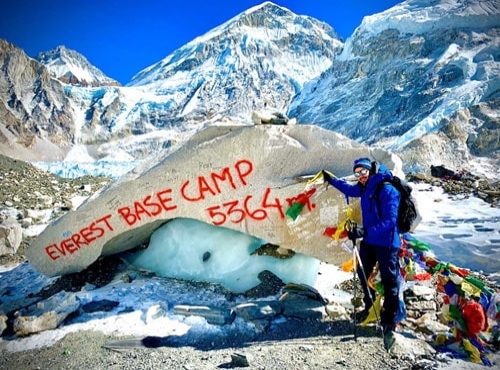
Reaching Everest Base Camp is an incredible achievement, but getting there safely is more important than reaching a particular destination on a particular day.
Our guides and porters are there to support you throughout the journey. If circumstances require a slower pace, additional rest, a change in plans or descent to a lower altitude, safety takes priority.
Everest Base Camp is the goal. Your safety comes first.
Why Trek with Scenic Nepal Treks?
We Are a Nepal-Based Company
We are based in Kathmandu.
That means you are working directly with a local Nepal trekking company rather than a distant intermediary.
We Know the Himalayas
Our team has extensive experience organizing and leading Himalayan adventures.
We Provide Local Support
Our team is available in Nepal before, during and after your trek.
We Understand International Travelers
We regularly work with travelers from different countries and understand that every guest arrives with different expectations, experience levels and travel plans.
We Can Customize Your Journey
If you want additional nights, sightseeing or another Nepal adventure before or after Everest Base Camp, talk to us.
We Focus on the Complete Experience
For us, the goal isn't simply:
"Reach Everest Base Camp."
The goal is:
"Have an incredible Nepal experience from arrival to departure."
Our Approach to Safety
High-altitude trekking always involves inherent risks.
We cannot promise that every journey will be completely free of problems.
Weather changes.
Mountain flights can be delayed.
Trails can change.
People can become sick.
Altitude affects everyone differently.
Our responsibility is to plan carefully, use experienced trekking staff, monitor conditions and make sensible decisions throughout the journey.
Your responsibility is to prepare properly, follow your guide's advice and tell us immediately if you feel unwell.
Together, these things help create a safer and more enjoyable trekking experience.
Responsible Tourism
We love the Himalayas and believe travelers have a responsibility to help protect them.
During your trek, we encourage you to:
- Carry your rubbish
- Reduce plastic use
- Respect local communities
- Respect Buddhist traditions
- Ask permission before photographing people
- Avoid wasting water
- Follow local environmental guidelines
- Respect wildlife
- Support local businesses where possible
The Everest region belongs not only to today's travelers but also to future generations.
Our Promise to Our Guests
At Scenic Nepal Treks, we don't want you to feel like another booking number.
When you arrive in Nepal, you are our guest.
Our team will help you understand the journey, prepare for the mountains and experience Nepal as comfortably and responsibly as possible.
We know that many of our guests have dreamed about seeing Everest for years.
We understand what that dream means.
And we want to help you experience it properly.